Made Well: The Difference Between Making and Manufacturing
One of the things I enjoy most about hosting the New England Endurance Podcast is that every so often, a conversation starts in one place and ends up somewhere much deeper. You think you are going to talk about hiking or running or the endurance community…and then somewhere along the way, the conversation opens up into something larger about work, identity, craft, or the way the world has changed.
That happened to me recently when I spoke with Richard Sachs.
If you’ve been around cycling for any length of time, especially in the Northeast, Richard’s name means something. He has spent decades building bicycle frames by hand, and over the years he has become associated not just with the bikes themselves, but with a certain philosophy around craft, racing, tradition, community, and independence. For many longtime cyclists, he is one of those figures who feels bigger than a product or a brand. He represents a way of doing things.
Going into the conversation, I expected to hear details about frame-building, cyclocross, and the old days of the sport. And we did talk about all of that. But what stayed with me most was not a technical detail or a racing story. It was a few simple things Richard mentioned in our chat. He said: “What I do is make things. What I happen to make is a bicycle frame” and later “you end up having a conversation or a collaboration with your materials and tubes.”
Those lines stuck with me.
Maybe the stayed with me because they capture something people in both the craft and manufacturing worlds can appreciate. I have spent much of my own career in manufacturing and he put words to something many of us sense, but do not always stop to examine: there is a real difference between “making” something and manufacturing something.
I want to be careful here, because this is not a sentimental argument against progress, and it is not an anti-manufacturing piece. I spent years leading Consolidated Sterilizer Systems (CSS), a manufacturer of steam sterilizers and autoclaves. I have deep respect for manufacturing and for the people who do it well. Good manufacturing improves lives and it creates jobs. It takes things that might otherwise be rare, expensive, or unreliable and makes them available to many more people in a dependable way.
But Richard’s comments reminded me that there is another dimension to work, one that can fade from view when industries mature, and everything gets pushed toward repeatability, efficiency, and sameness. Later in the conversation, Richard described frame building this way: Anyone can read a procedure. Not everyone can truly weld at a high level. The best welders were not simply following instructions in a mechanical way. They had to be in tune with the material. They had to understand heat, response, fit-up, distortion, consistency, and subtle variation. They had to recognize what the metal was doing in real time and adjust accordingly. They had to bring feel, judgment, and experience to the job in order to make a truly good bead.
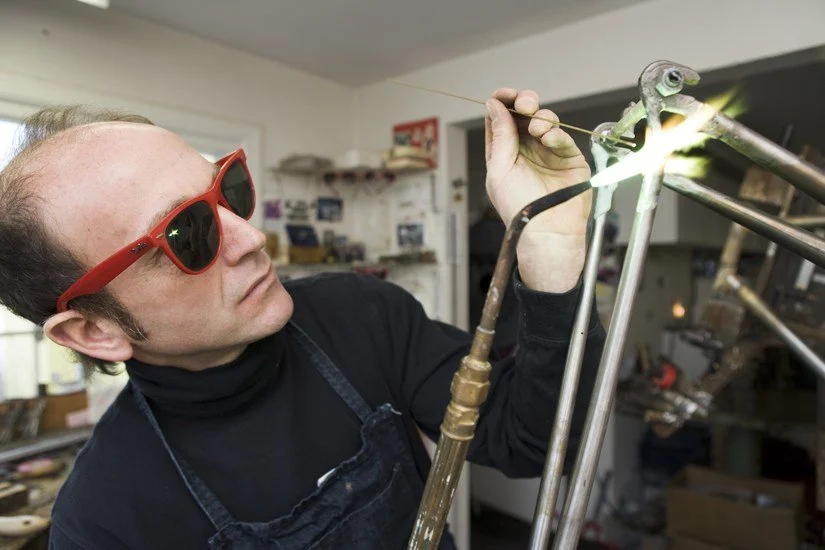
Richard Sachs at work at his bench.
At CSS, where we built specialized equipment with sophisticated machinery, inspections, documentation, and all the rigor you would expect when manufacturing pressure vessels and steam sterilizers. In that kind of environment, consistency and repeatability matter enormously, and it is easy to see why more of that world is moving toward automation, including the use of robotics. For products like steam sterilizers, that is often the right direction. But before a process is automated, or in places where it is still done by hand, the quality of the result depends heavily on the person doing the work. One of those areas for us was welding the pressure vessel.
In some settings, especially in custom work, the human relationship to the material is inseparable from the final product itself. Anyone who has ever made anything real knows that the work rarely unfolds exactly as planned. Materials behave a certain way. Tolerances stack up. Tools cooperate until they do not. Experience and judgement matter. The best builders, machinists, fabricators, mechanics, and craftspeople do not just execute steps, they respond and adjust. They feel their way through the work. They bring something to it that no process sheet fully captures. That is not a rejection of systems. It is simply an acknowledgment that the human element is still doing more of the work than we sometimes admit.
Cycling is actually a pretty good lens for this. A generation or two ago, the handmade frame builder occupied a much more central place in the culture of the sport. There were builders whose names carried almost mythic significance. The bike itself still had a visible connection to the person who made it. Over time, that changed. The sport professionalized further. Global manufacturing expanded, materials evolved. Carbon, automation, tooling, and massive production capability shifted the center of gravity. The bikes got lighter, faster, and more consistent. Modern manufactured bikes can be incredible. But with mass-produced bikes comes a growing distance between user and maker. The number of fingerprints on the finished product gets smaller. The sense that this thing emerged from a specific person, with a specific philosophy and a specific hand, became more rare.
That is not just a cycling story. It is a modern economy story and you see it all over the place. Products are refined, optimized, and improved. Supply chains get global. Best practices become standardized. Over time, one company starts to look a little more like the next. Then one product starts to feel a little more like the next. Eventually, you wake up and realize that many things are excellent, but a surprising number of them are also oddly interchangeable.
That is the tension Richard put his finger on…through the lens of frame building.
At one point in the episode, Richard said, “What I do care about is my relationship with what’s on my bench.” I love that quote too. No buzzwords here! No management-speak. Just a person describing his actual relationship to the work and there is something refreshing about that.
We live in a time when a lot of people operate one or two layers removed from the real thing. The language around work gets abstract fast. Strategy. Growth. Leverage. Innovation. Transformation. Some of those words are useful and many are overused. Every now and then, it is healthy to return to something more basic: What is the work? What does it take to do it well? What kind of relationship do you have with the materials, tools, process, people, and standards in front of you?
That question matters whether you are a frame builder in Connecticut, a welder in a manufacturing plant, a machinist, a product designer, or a leader trying to build an organization with some soul.
What stayed with me from my conversation with Richard Sachs was a renewed appreciation for work done with care. Just the real thing: a person engaged with the material, the process, and the standard they are trying to meet. That idea reaches well beyond bicycle frames.
If you come from manufacturing, you have probably known people like this: The welder who can read the “bead” and adjust without needing to announce it. The machinist who notices something is slightly off before the print or the gauge tells the story. The operator or fabricator whose work carries a level of consistency that comes not only from training, but from attentiveness and pride. They may be working inside a highly structured environment, but what they bring to it is unmistakably human.
Making and manufacturing are not enemies, and they are not even opposites in many cases. Great manufacturing still depends on people with feel, judgment, and a deep understanding of materials, tolerances, and process. That, to me, is the distinction worth preserving. That was the deeper point I took from Richard’s perspective. He was talking about bicycle frames, but he was also pointing to something broader: the human signature inside good work. When everything is discussed only in terms of speed, scale, and efficiency, it becomes easy to overlook the human contribution that often separates good work from exceptional work.
In a world where more and more things are optimized, standardized, and interchangeable, that kind of work stands out. It reminds us that some of the things we value most are not only effective or efficient but thoughtful, intentional, and… made well.
(Full episode from my interview with Richard can be found on your favorite podcast platforms.)