10 Things I Learned in a Room Full of Sports Cardiologists
Heart-health takeaways for masters endurance athletes from an amateur athlete, former coach, and someone who has dealt with AFib.
On September 25–26, 2026, I attended the Boston Sports Cardiology Summit, sitting in a room with more than 100 cardiologists. I came as a lifelong endurance athlete, a former USA Cycling certified coach, a Harvard Advanced Leadership Initiative fellow, and someone who has dealt with atrial fibrillation (AFib).
As someone without a medical degree, I had plenty to learn. My notebook filled up quickly. Some questions were basic: What does that acronym mean? Others were questions many of us have: How much protection does fitness give me? Which symptoms matter? And if something is wrong, can I keep doing the sport I love?
My own AFib diagnosis had already made those questions personal: Can I keep dropping the hammer on the Tuesday ride? What’s safe?
The summit also marked the launch of the Sports Cardiology Society, bringing together professionals focused on athletes’ heart health. Sports cardiology has been around for decades, but its continued evolution, and attention to helping athletes stay active, is encouraging for those of us thinking about our future in sport.
For fellow amateur endurance athletes, especially those of us in our 40s, 50s, and beyond, here are ten takeaways I would bring back to the group ride.
1. Most of us are masters athletes, even if we don’t call ourselves that.
The American College of Cardiology describes masters athletes as “adults over 35 who train more than five hours a week and pursue performance goals alongside health goals.”
That sounds like a lot of people on our group rides and in our running clubs. You don’t need to be winning races. You might be working toward a faster 5K, training for a century, or trying to keep up on the Tuesday ride. That’s why this topic feels relevant to so many of us.
2. Being fit helps enormously but it doesn't make us immune.
Exercise is one of the most valuable things we can do for our cardiovascular health. But we can have a strong aerobic engine and still have high blood pressure, plaque in our arteries, or a heart rhythm problem. Dr. Ben Levine's presentation reinforced this: fitness is protective and coronary artery disease can still be present.
That made me think about which numbers we pay attention to. As athletes, we know our pace, power, and resting heart rate. Our blood pressure, cholesterol, and family history deserve similar attention.
Finding out you have coronary artery disease can be unsettling, especially when you’ve spent years exercising. But there are ways to manage it, including medication when appropriate. Needing treatment doesn’t mean our training has failed or its benefits have disappeared. Exercise and medical treatment can work together to protect our health.
For those who want to dig into the science, the 2026 masters athlete consensus explores these ideas in more detail.
3. What sport means to us belongs in the medical conversation.
One phrase in my summit notes stood out: “Restriction from sports is not benign.” Training gives many of us friendships, structure, stress relief, and a sense of who we are. Giving it up affects much more than fitness.
That’s why the speakers emphasized shared decision-making: the clinician explains the condition, options, and risks; the athlete explains their goals and what sport means to them. Together, they develop a plan. I love this approach. Sometimes restrictions are necessary, but I’d want to understand what I can do now, what needs to wait, what symptoms should stop me, and when we’ll review progress.
Help your doctor understand what your training involves. “I exercise regularly” says much less than “I ride four days a week, do hard group rides, and want to train for a century.”
4. Pay attention when your “normal” changes.
For athletes, a change in performance can be an important clue that something needs attention. Two cases at the summit brought this home for me.
The first involved an endurance athlete who was finding exercise increasingly difficult. He had no obvious palpitations or chest pain, but he turned out to have AFib. In another presentation, Dr. J. Sawalla Guseh described an athlete whose earlier treadmill performance had appeared reassuring despite a significant decline from his own baseline. Further evaluation uncovered serious disease.
Both cases reminded me that our own baseline matters. You can still perform well compared with other people your age while experiencing a meaningful decline in what’s normal for you. One bad workout isn’t a diagnosis, but persistent, unexplained changes in breathing, stamina, or effort deserve a conversation with your doctor.
This is where knowing your training can help you explain the concern. Bring specifics to an appointment: when the change started, what effort brings it on, and how it compares with your usual workouts.
Some symptoms need immediate attention. New chest pressure, fainting during exercise, or severe unexplained breathlessness calls for stopping and seeking urgent help. For possible heart attack symptoms, call 911 rather than finishing the workout or driving yourself. American Heart Association guidance.
5. AFib treatment should account for the life you want to lead.
Having dealt with AFib myself, this session had my full attention. Long-term, high-volume endurance exercise is associated with increased AFib risk in some groups, particularly men. That doesn’t explain any individual’s diagnosis or cancel out the benefits of exercise, but it’s something our endurance community should understand. We also need more research in female athletes.
Katie Stewart’s presentation emphasized that treatment depends on symptoms, how often episodes occur, and how they affect daily life and performance. Some medications slow the heart rate and can make exercise feel harder. Catheter ablation (a procedure that targets the electrical signals driving AFib) can be an early option for symptomatic athletes. It has benefits and risks, and it doesn’t guarantee that AFib won’t return or that medication will no longer be needed. The HRS athlete arrhythmia consensus explains these options.
My takeaway: ask how each treatment could affect your symptoms, training, and long-term health. Stroke prevention deserves a separate discussion, even when you feel well.
6. The right test depends on the question.
The summit helped me understand what different heart tests tell us. An electrocardiogram (ECG or EKG) records electrical activity. An echocardiogram (echo) uses ultrasound to assess heart structure and function. A rhythm monitor captures episodes that come and go. Exercise testing, including a cardiopulmonary exercise test (CPET), examines how the body responds to exertion.
Each answers a different question, and no single test gives the whole picture or guarantees that exercise is safe. Interpretation matters because training can change heart size, resting heart rate, and electrical patterns. An unusual finding may be a normal adaptation, but it shouldn’t automatically be dismissed as “athlete’s heart.”
Two questions worth asking: “What are we trying to learn?” and “How would the result change my care?”
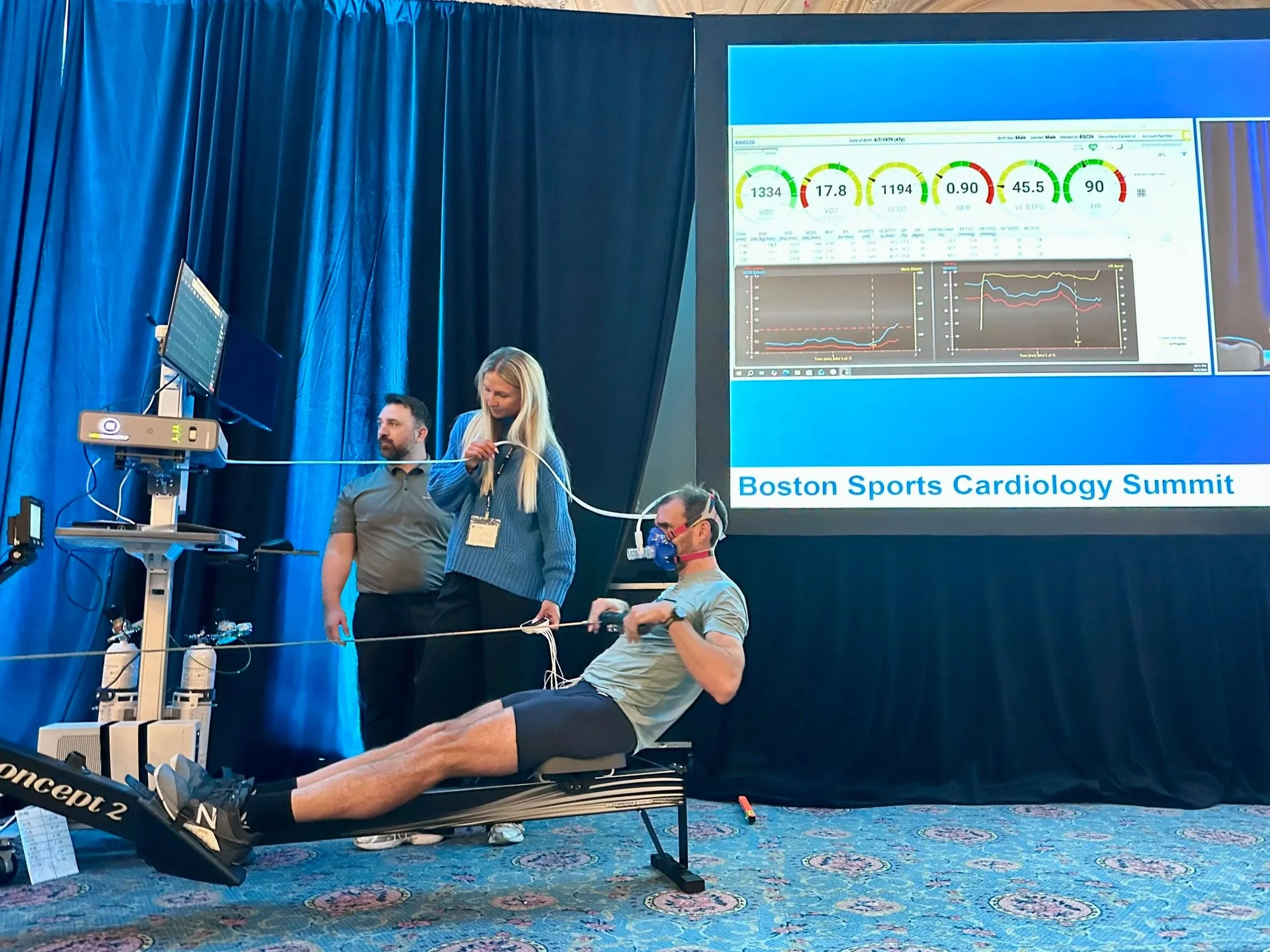
Demo of a Cardiopulmonary Exercise Test (CPET) at the summit by the MGC Diagnostics.
7. A calcium score is useful information. It isn't the whole picture.
A coronary artery calcium scan, or CAC scan, measures calcified plaque in the arteries supplying the heart. Some studies have found more calcium in highly trained endurance athletes, which prompted a question in my notes: If the plaque is calcified, does that mean it’s okay? We shouldn’t assume that. Higher calcium still matters, even when fitness is high, and athletes can have noncalcified plaque too. ACC discussion of the evidence.
A different test, coronary CT angiography (CCTA), uses contrast dye to show both calcified and noncalcified plaque and assess how much an artery is narrowed. It can help when symptoms or other findings warrant a closer look, but it isn’t an automatic follow-up to every calcium scan. Coronary CT imaging guidance.
My takeaway: a high calcium score deserves a conversation about prevention and whether further evaluation is needed. By itself, it doesn’t mean you must stop exercising.
8. Finding a narrowed artery doesn’t automatically settle the treatment.
One debate at the summit showed why treating coronary artery disease requires looking beyond the scan. The question: when should an athlete receive a stent to help open a narrowed artery, and when might medication and management of risk factors be the better approach?
The answer depends on the person. Symptoms, the location and severity of narrowing, blood flow during exercise, and the type and intensity of exercise the athlete wants to return to all matter. For stable disease, medication and follow-up may be appropriate; other findings may warrant a procedure. Evidence specific to masters athletes still has gaps, making an individualized discussion especially important. The 2026 masters athlete consensus explores these decisions.
My takeaway: ask, “What benefit would this treatment offer in my situation, and what are the alternatives?”
9. Wearable data is most useful when it comes with context.
Dr. Jeffrey Hsu’s session was especially relevant for those of us who track everything with a WHOOP, Oura, Apple Watch, or Garmin. Heart-rate trends—and ECG recordings from devices that offer them—can help a clinician understand what’s happening.
But these devices have limits. Movement can distort readings, and estimated VO₂ max and recovery scores are calculated rather than directly measured. A good recovery score doesn’t mean your heart is ready for hard exercise. An irregular-rhythm alert needs medical interpretation, and no alert doesn’t rule out a problem. The JACC wearable technology reviewexplains these limitations.
To make the data useful, save any unusual recording and note what you were doing and how you felt. That context helps your clinician connect the numbers with your symptoms.
10. Have an emergency plan before you need one.
Sudden cardiac arrest during organized distance races is rare, but preparation matters. Dr. Aaron Baggish presented findings from the updated RACER study showing that survival improved substantially even though the rate of cardiac arrest did not significantly change. The study can’t establish what caused that improvement, but it reinforces the importance of recognizing an emergency quickly, starting CPR, and having access to an automated external defibrillator (AED). RACER study, JAMA, 2025.
For our riding and running groups, that means planning ahead: Who knows CPR? Where could we access an AED? Who would call 911, and how would we describe our location on a remote route? These are questions to answer before we need them.
We plan our routes and workouts. Preparing to help a training partner deserves the same attention.
What I’m taking forward:
The summit sharpened the question behind my Harvard Advanced Leadership Initiative project: How can we help active adults understand their heart health and make informed decisions about the sports they love?
My AFib experience showed me how many questions can sit between a diagnosis and the next group ride. I want to help athletes find clearer information, have better conversations with their doctors, and get care that understands their goals.
I want to keep doing this for years to come…and help others do the same.
What heart-health question do you wish someone had helped you answer earlier?